Further licenses may be issued if market conditions permit. The TRA will undertake a periodic review of the state of competition in the market and the consumer benefits that have resulted in order to make any such decision.
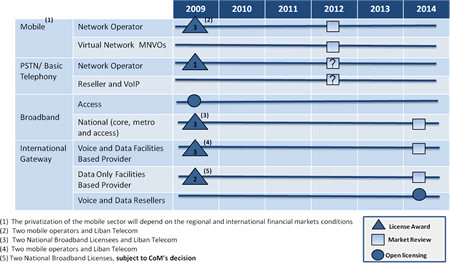
One of the TRA’s major goals is the introduction and development of a wide-range competition in the market. This will encompass facilities, services and technology, with the latter benefiting from a policy of leaving the choice of technologies to service providers as long as it is based on International Standards. This points out to a number of interesting future investment opportunities. An overview of future licenses to be granted and market assessments to be made in the coming four years can be found below.
The TRA has undertaken the initial market assessment in 2008 and intends to review the telecommunications market and more specifically the Mobile and PSTN markets in 2012. This will assess the competition level and the possibility of introducing mobile virtual network operators. The latter will depend on the TRA’s assessment of the impact with regard to end-user prices, quality of service and service innovation.
The anticipated establishment of Liban Telecom represents another major opportunity for the development of the competition in the market. Article 46 of the Telecommunications Law 431/2002 provides for the selling within a period of maximum 2 years following its incorporation, of up to forty percent (40%) of Liban Telecom to a strategic partner.
Mobile Licenses Up to November 2008, the mobile market was served by two mobile managers which, since 2004, operate the two state-owned mobile networks under management agreements. These agreements were entered into with FalDete and MTC Lebanon who manage MIC1 (Alfa) and MIC2 (Touch), respectively. The managers were responsible for the day-to-day management of the mobile businesses, which includes operations, billing, marketing, maintenance and other activities. Both managers received contractually fixed monthly amounts for operational expenditures and collected revenues were transferred in full to the MoT each month. The terms of the agreement did not allow the network managers to make changes to end-user service prices unless specifically authorized by the Government.
In November 2007, the TRA jointly with the Higher Council for Privatization (HCP) has launched an international auction for the acquisition of the two incumbent mobile businesses as well as two 20-year licenses. Due to the global financial crisis, the auction process has been lately discontinued by the Council of Ministers.
Upon the termination date of the Management Agreements with FalDete and MTC Lebanon in November 2008, and the failure in negotiating an extension with FalDete, the Council of Ministers has extended the terms of MTC’s agreement for two months and has appointed the MoT to run a tender for the management of both mobile businesses. During this transition period, the TRA has been working with the Ministry of Telecommunications in the preparation and optimization of the new Quality of Service indicators to be included in the new management agreements and the TRA’s role in monitoring the provision of mobile services. A tender took place in January 2009 and both Orascom Telecoms and Zain were appointed as the New Network Managers for MIC1 and MIC2 respectively for a period of 2 years (one year term subject to only one year renewal). The new Management Agreement with Orascom Telecoms and Zain will start on February 1st 2009.
The TRA remains strongly committed to the privatization and liberalization of the mobile market; the mobile licenses as drafted by the TRA will allow the provision of any mobile service over the licensed frequencies, including 3G mobile broadband. Licensees may deploy the mobile network facilities and technologies of their choice in line with the license requirements. In addition, each mobile licensee will be granted the right to install, own and operate a facilities-based international gateway to provide all international services to its end-users.